

Quenched and tempered plate is straightforward to weld and unforgiving of the two things that go wrong with it: hydrogen, and an uncontrolled cooling rate in the heat affected zone. This article sets out the controls for both.
The tables of chemistry, preheat and heat input reproduced here are the plate manufacturer’s published data. Grade designations and published values change, so confirm the current figures with the manufacturer before writing a procedure against them.
General Information
Quenched and tempered plate of these grades can be readily welded using any of the conventional low hydrogen welding processes.
Their low carbon content and carefully balanced, but relatively small additions of alloying elements (Mn, Cr, Mo, B) ensures good weldability, in addition to the advantages of high strength, impact toughness and high hardness.
Hydrogen Control
Welding quenched and tempered plate soundly means being more careful about the levels of hydrogen, preheat temperatures and arc energy inputs in order to minimise the hardening and maintain the properties of the weld Heat Affected Zone (HAZ).
Particular attention must be paid to the control of hydrogen content to minimise the risk of weld and HAZ cracking. Weld hydrogen content is minimised by careful attention to the cleanliness and dryness of the joint preparations and the use of hydrogen controlled welding consumables.
Get the storage and handling requirements from the consumable manufacturer. Heated storage and reconditioning ovens are required for manual metal arc electrodes.
Heat Affected Zone (HAZ) Property Control
The HAZ, a region directly adjacent to the weld, experiences a thermal cycle ranging from unaffected parent plate to near melting at the fusion boundary.
The properties of this zone are determined by the steel composition as well as the cooling rate.
Steel Composition
Grades and chemical compositions divide into categories based on carbon equivalent and CET, as in Table 2:
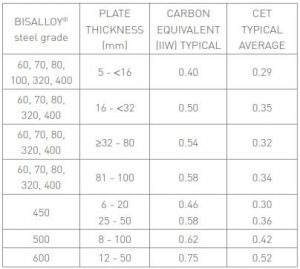
Table 2 C-Eq and CET Averages of Bisalloy QT Steels
Notes:
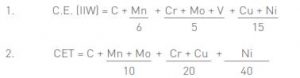
The CET formula is based on similar elements to the CE[IIW] formula with the exception of Vanadium, although carbon is considered to have more significance than the other elements.
These categories give an indication of the degree of care required in the proper selection of welding preheat/heat inputs.
Cooling Rate
Limitations on both preheat and heat input are necessary to ensure that the HAZ cools at an appropriate rate and that the correct hardness and microstructure are achieved. Too slow a cooling rate can result in a soft HAZ and thus a loss of tensile and fracture toughness properties. Too rapid a cooling rate produces a hard HAZ which may cause loss of ductility.
Cooling is controlled by a balance between preheat and heat input for a particular plate thickness and joint configuration.
Preheat and Heat Input
Preheat and heat input recommendations are outlined in tables 3 and 4 will ensure that the cooling rate of the HAZ is satisfactory.
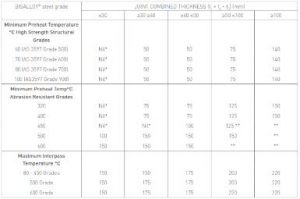
Table 3 Recommended Preheat/Interpass Temperatures for Bisalloy QT Steels
- Chill must be removed from plates prior to welding.
** Refer to Bisalloy Steels for availability, preheat/interpass requirements.
***A reduced 100ºC min preheat can be used for product ≥50 to 60 JCT
Note: that under rigid weld joint restraint or high ambient humidity conditions preheating temperature should be increased by 25ºC.
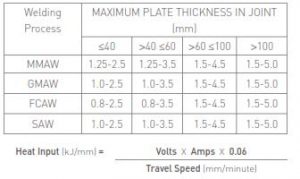
Table 4 Permissible Heat Inputs for Bisalloy QT Steels
Note: For thicknesses up to 12 mm in structural grades, the maximum arc energy may need to be limited to 1.5 KJ/mm maximum in specific applications
Helpful Hints
General rules for good quality welding of quenched and tempered plate:
- Use a low hydrogen process, for example, GMAW (MIG), FCAW (gas shielded)
- Follow the consumable manufacturer’s storage and handling requirements for low hydrogen consumables
- Clean joint area of all contaminants prior to welding
- Remove 1 to 2 mm from flame cut or gouged surfaces by grinding
- Select the recommended preheat, interpass and heat input parameters
- Position for downhand welding where possible
- Always use stringer beads, never wide weaves
- Use lower strength consumables on root runs and fillet welds (when the design permits)
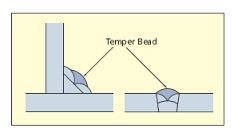
- Use temper beads when necessary
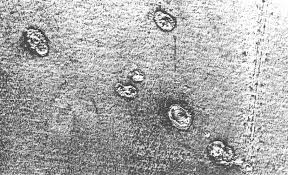
- Arc strikes to be made in the joint preparation
- Particular attention should be given to tack welds re preheat, heat input and joint cleanliness requirements
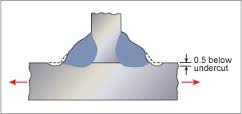
- Grinding toes of fillet welds is particularly important in fatigue applications
References/Further Reading
- AS 1554 Part 4 Welding of Q&T Steels
- AS 1554 Part 5 Welding of Steel Structures Subject to High Levels of Fatigue Loading
Source material supplied by Bisalloy Steels, first published on the AWI site in 2017. Product names are the supplier’s. Republished with the supplier marketing removed.