Welding supervision is often described as low level management. That description does not survive contact with what the role actually requires.
In AWI’s experience most people in the fabrication industry have a broad idea of what a welding supervisor does, and very little detail on what a competent one does. A competent welding supervisor carries as much of the quality assurance of a fabricated product as the design engineer or the production manager. On that basis the role sits closer to middle management than to a leading hand.
For background: the competency units for welding supervision were developed by Manufacturing Skills Australia, working with the industry skills councils, after a long argument in the sector about who should define them. Manufacturing Skills Australia has since been disbanded, but the units it wrote are still the framework.
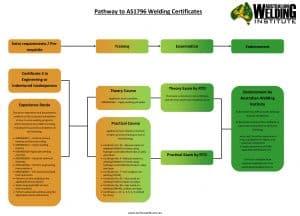
These competency units were arranged under a system of training packages, which replaced the national, broader based modular system of training and are underpinned by ‘pre-requisites’.
The pre requisites were put in place to ensure that a welding supervisor had completed the necessary groundwork, meaning trade experience and welding training, before taking on the role.
So the framework consists of:
- A system of training packages,
- Pre requisite training (entry requirements)
- Clearly defined skills and knowledge
Under the Australian Quality Training Framework (AQTF), Registered Training Organisations (RTO’s) are obligated to ensure students have the necessary pre requisite training prior to starting their welding supervision education. This ensures the candidate exits the welding supervision course and has the broad knowledge and skills that competent welding supervisors require, to be able to perform the role they are employed to do.
AWI members report a progressive decline in the competence of welding supervisors. The most likely cause is a mismatch between two systems that are supposed to agree.
The two standards that govern the role are:
- AS 1796, Certification of welders and welding supervisors
- AS 2214, Certification of welding supervisors, structural steel welding
Both set their own entry criteria, and those criteria sit independently of, and in places contrary to, the competency units mandated under the AQTF.
As an example, the latest two revisions of the above standards allow anyone with “A qualification in engineering, metallurgy or welding”to have direct entry with no practical welding experience at all, and no prerequisite training.
The AWI asks these simple questions:
- How can a person with a qualification in metallurgy (or perhaps NDT certification) be a competent welding supervisor, when they have no practical experience in welding?
- How can such a person have an in depth understanding of how welding defects occur when they may not have been at the ‘hot end’ of the various methods of welding?
- How will they be able to ensure welding machines are set up correctly and safely?
- Could they demonstrate the use of an oxy-fuel set to a workshop hand?
- Would they be competent to make decisions on a fabrication build sequence?
- Are they able to review a welding procedure and comment on it usefully?
In AWI’s experience the answer to all of those questions is that they cannot, which is why there are welding supervisors certified under AS 1796 who are not equipped for the job they hold.
The introduction of IIW qualifications alongside the Australian standards has compounded the problem. For a period the Australian route to AS 1796 and AS 2214 was not offered at all, in favour of the IIW qualifications, which caused years of confusion about which credential an employer should be asking for. More recently there have been attempts to combine the IIW International Welding Specialist qualification with AS 1796, which dilutes both.
Whilst there are some similarities between IWS and the two Australian standards, there are as many differences. One stand out difference is that the IIW syllabus is based on ISO and European (EN) standards, which is great for the twenty seven countries that presently make up the European Union but unfortunately they are not widely used in Australian welding fabrication. AS 1796 and AS 2214 are derived from the AS 1200 and AS 1554 suite of standards respectively.
Another significant difference is the entry requirements.
The AWI understands the fact that Australian Standards are a minimum requirement, we also understand the importance of underpinning knowledge to ensure competence, which is why we have modified our process/system to overcome the conflict that exists between the Australian standards and competency standards.
So what is our attempt to reverse this apparent decline?
Firstly, our focus is on providing a rationed / streamlined alternative to the overcomplicated system currently on offer.
Secondly ensure those sitting the examination have the necessary underpinning skills and knowledge.
Finally ensure the examinations are written in such a way that reflect the roles and responsibilities of welding supervisors in Australia.
So our point of difference is;
AWI issues AS 1796 and AS 2214 welding supervisor certification, and does so in line with both the intent of the standards and the AQTF. AWI does not deliver the training. And while we do not exclude engineers or NDE technicians as such, from gaining a welding supervisor qualification, we have mandated that applicants without a trade background must complete the pre-requisite units with an approved RTO, therefore providing them with some practical experience. Essentially, the AWI have elected not to allow direct entry of Engineers and NDE technicians without this requirement.
Similarly candidates that have followed the IIW route to certification must show evidence of having gained the appropriate entry requirements.
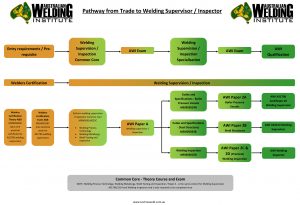
The AWI welding supervisor certification pathway is set out at /certification/supervisor/.