
Weld consumable calculator

Weld metal and consumable quantity for a single V butt weld and for a fillet weld, worked from joint geometry, weld length and the deposition efficiency of the process. Butt weld first, fillet weld second. Both update as you type, and both print the formula and the assumptions below so the number can be checked rather than trusted.

Nothing you type leaves your browser. This runs in the page, in JavaScript. There is no form to submit and no server involved, so your joint details are not transmitted, stored or logged. Why that matters.

Butt weld, single V preparation

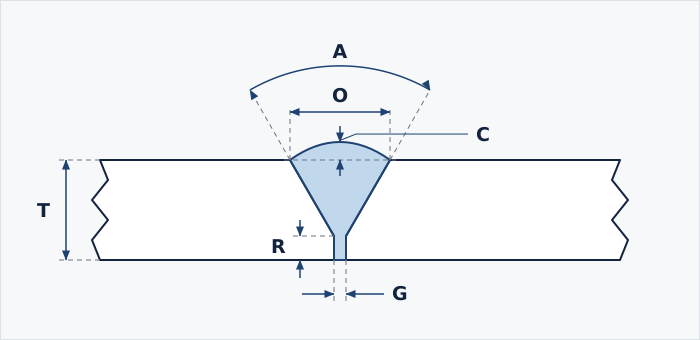
Enter the preparation. Opening width (O) is calculated for you from the thickness, the included angle and the root, so you can check it against the drawing before you read the weight.
Process and material

The number is the deposition efficiency

Sets the density used for the weight

Joint geometry


Total angle between both bevel faces

Blank counts as zero

Root face height, blank counts as zero

Reinforcement above the plate surface

Butt weld result

Updates as you type

Opening width (O)
mm

Cross sectional area
mm2

Weld metal per metre
kg/m

Total weld metal weight
kg

Consumable usage
kg/m

Total consumable required
kg
At 59% deposition efficiency. Add your own allowance for tacks, run off, repairs and wastage: 5 to 10 per cent is usual.

Fillet weld

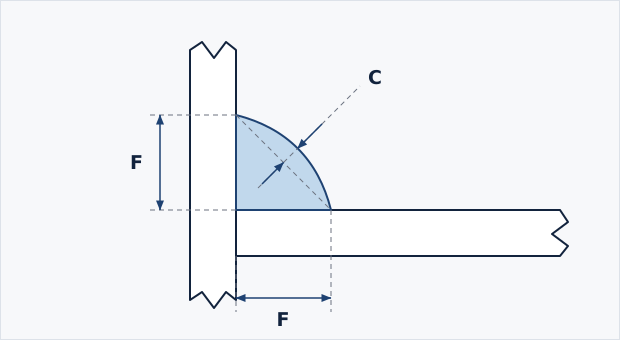
Equal leg fillet. Fillet size (F) is the leg length, not the throat.
Process and material

The number is the deposition efficiency

Sets the density used for the weight

Fillet geometry

Leg length of an equal leg fillet

Convexity above the mitre line, blank counts as zero

Fillet weld result

Updates as you type

Cross sectional area
mm2

Weld metal per metre
kg/m

Total weld metal weight
kg

Consumable usage
kg/m

Total consumable required
kg
At 59% deposition efficiency. A fillet leg oversize by 1 mm on an 8 mm weld costs about 27 per cent more consumable, which is where fabrication money usually goes missing.

Formula and assumptions

Butt weld cross sectional area, single V

O = G + 2 x (T - R) x tan(A / 2)
Root land area = G x R
Bevel area = (T - R)^2 x tan(A / 2)
Cap area = (2 / 3) x O x C
Cross sectional area = root land + bevel + cap [mm^2]
A is the total included angle, so each bevel face sits at A/2. Enter 60 for a 60 degree included V, not 30.

Fillet weld cross sectional area

Triangle area = F^2 / 2
Convex cap area = (2 / 3) x (F x sqrt(2)) x C
Cross sectional area = triangle + convex cap [mm^2]
F x sqrt(2) is the face width across an equal leg fillet, which is the base of the convexity. Design throat is F / sqrt(2).

From area to weight

Weld metal per metre = area (mm^2) x density (g/cm^3) / 1000 [kg/m]
Total weld metal = weld metal per metre x weld length (m) [kg]
Consumable usage = weld metal per metre / (efficiency / 100) [kg/m]
Total consumable = total weld metal / (efficiency / 100) [kg]
For carbon steel at 7.85 g/cm3 that first line reduces to the familiar area x 0.00785.

Assumptions

  • Steel, unless you change the material. The default is carbon and low alloy steel at 7.85 g/cm3. The same joint in aluminium weighs roughly a third as much. The material dropdown carries austenitic stainless steel at 8.00 g/cm3 and aluminium at 2.70 g/cm3. Note that the deposition efficiency figures in the process list were compiled for steel consumables, so for aluminium and stainless treat the efficiency as a starting point and use the figure from your own consumable supplier.
  • Single V, one side, symmetrical. A double V of the same total thickness has roughly half the bevel area for the same included angle, so run each side separately and add the two results. A U preparation, a J preparation and a compound bevel are not covered by this geometry.
  • The cap is treated as a parabolic segment, area = (2/3) x base x height. That is the standard estimating approximation for a normally profiled cap and it applies to both the butt reinforcement and the fillet convexity.
  • Root land area is taken as G x R. This is the convention the AWI calculator has always used, and it is kept so that a result can be checked against the previous version. Read it as a known simplification: it counts the root gap only over the height of the root face. The strict trapezoid form of the same preparation adds a further G x (T – R) mm2, because the gap continues up through the bevel region. On a 12 mm plate with a 3 mm gap and a 3 mm root face that is another 27 mm2, roughly 37 per cent. If your gap is wide and your plate is thick, add that term back by hand before you order.
  • Deposition efficiency is deposited weld metal as a fraction of consumable purchased. Consumable required is weld metal divided by that fraction. The figures cover normal stub loss and spatter for each process. They do not cover a part used spool written off at the end of a job, consumable damaged by poor storage, or redrying losses.
  • No allowance for anything other than the weld itself. Tack welds, run on and run off tabs, weld repairs, excess reinforcement ground back off and general wastage are all on top. Most estimators add 5 to 10 per cent.
  • Non numeric or negative entries produce a dash, not a number. A blank root gap, root thickness or cap height counts as zero. Thickness, angle and length have to be entered before a total appears.

Worked examples

Check these by hand, or against the previous version of the calculator, before you rely on the tool.

Butt weld example

12 mm plate, 60 degree included V, 3 mm root gap, 3 mm root face, 2 mm cap, 10 m of weld, stick (MMAW) low hydrogen at 59 per cent, carbon steel.

tan(30 deg) = 0.577350
O = 3 + 2 x 9 x 0.577350 = 13.39 mm
root land = 3 x 3 = 9.00 mm^2
bevel = 9^2 x 0.577350 = 46.77 mm^2
cap = (2/3) x 13.392 x 2 = 17.86 mm^2
area = 9.00 + 46.77 + 17.86 = 73.62 mm^2
weld metal = 73.62 x 7.85 / 1000 = 0.578 kg/m
total metal = 0.578 x 10 = 5.78 kg
consumable = 0.578 / 0.59 = 0.980 kg/m
total needed = 5.78 / 0.59 = 9.80 kg

Fillet weld example

8 mm equal leg fillet, 1 mm convexity, 20 m of weld, flux cored (FCAW) E71T-1 at 85 per cent, carbon steel.

triangle = 8^2 / 2 = 32.00 mm^2
convex cap = (2/3) x (8 x 1.414214) x 1 = 7.54 mm^2
area = 32.00 + 7.54 = 39.54 mm^2
weld metal = 39.54 x 7.85 / 1000 = 0.310 kg/m
total metal = 0.310 x 20 = 6.21 kg
consumable = 0.310 / 0.85 = 0.365 kg/m
total needed = 6.21 / 0.85 = 7.30 kg

Where this sits against the standards

Consumable quantity is a commercial number, not a compliance number, so no standard sets it. Two connections are worth making anyway.

  • The joint preparation you enter here has to be the preparation on the qualified welding procedure. Changing an included angle or a root gap to save consumable can move you outside the qualified range. ISO 15614 sets out the essential variables.
  • Consumable control, including storage, redrying and traceability from batch to joint, is a quality system requirement. AS/NZS ISO 3834 covers what a fabricator has to be able to produce.

Disclaimer

AWI provides this calculator as a free resource to the welding industry. Validate the accuracy of any result before relying on it. AWI accepts no responsibility for consequent losses from the use of these resources.